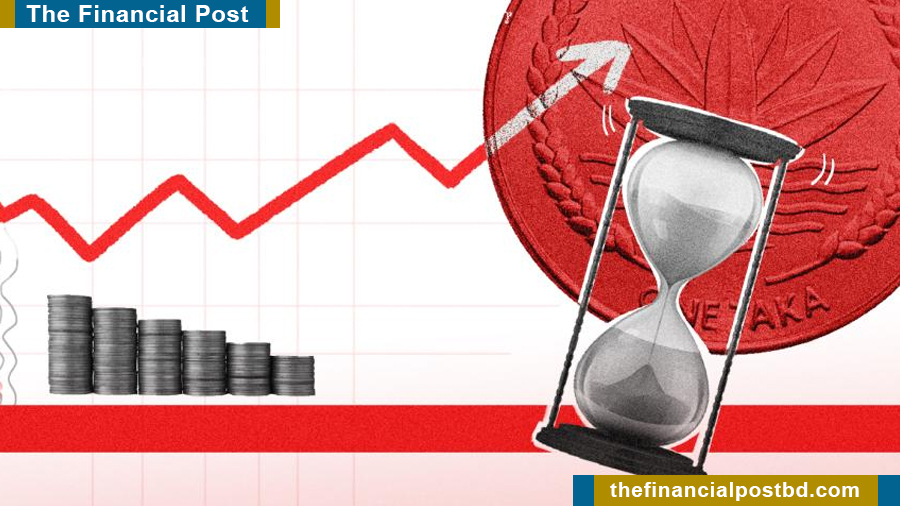
Amid an intense global crisis and a turbulent domestic economic environment, the newly elected BNP government is preparing to announce the budget for the 2026–27 fiscal year. The proposed budget size is expected to range between Tk9 lakh 20 thousands and Tk9 lakh 30 thousands.
It comes at a time of high inflation, rising commodity prices, instability in the energy sector, banking and financial sector reforms, a massive revenue shortfall, and slow implementation of development programs.
In this challenging situation, newly appointed Finance Minister Amir Khasru Mahmud Chowdhury is preparing to unveil a high-expenditure budget with a record deficit. At the same time, Prime Minister Tareq Rahman is also expected to make his parliamentary debut by attending the budget session as head of government. According to plans, the Finance Minister will present his first budget proposal in the National Parliament on June 11.
According to sources in the Finance Division, the government is under pressure to implement several public-oriented programs to fulfill election promises. These include Family Card, Farmer Card, and canal excavation programs. The Family Card initiative alone is expected to cost Tk 1.3 trillion over five years.
In addition, implementation of the Ninth National Pay Scale for government employees is expected to cost approximately Tk 1.06 trillion in a single year. The government is also considering tax reductions on essential imports to provide relief in commodity markets, which may increase subsidies under food assistance programs. Subsidies in the energy sector are also expected to rise due to the continuation of capacity charges introduced under the previous administration.
As a result, overall expenditure is projected to increase significantly. Total government revenue is estimated at Tk 6.95 trillion, while the budget deficit may reach Tk 2.35 trillion. To cover the shortfall, the government may borrow Tk 1 trillion from foreign sources and Tk 1.35 trillion from domestic sources.
The Annual Development Program (ADP) for the new fiscal year could reach Tk 3.08 trillion.
To manage financial pressures and meet conditions from the IMF, the government has already increased fuel prices less than two months after assuming office and is considering raising electricity prices as well. This has significantly increased living costs, particularly for low-income citizens, who are struggling to cope with inflation.
To maintain revenue flows, the government is considering several difficult measures, including increasing surcharges on wealthy individuals, raising tax-free income thresholds, and imposing taxes on transport commonly used by lower- and middle-income people, such as motorcycles and battery-powered rickshaws.
However, in an effort to ease public pressure, import taxes on food products may be reduced to help lower prices of daily essentials. The government is also planning to broaden the tax net, including bringing informal sectors under taxation.
Economists say this budget carries special significance for the BNP government, which has returned to power after nearly two decades. Expectations are especially high as this is the party’s first budget after taking office.
Former World Bank Dhaka Chief Economist Dr. Zahid Hossain said that people have elected a government through voting after a long time and public expectations are therefore much greater. He noted that the first budget will attract attention from all sectors of society.
Meanwhile, Bangladesh had to repay a record $4.09 billion in foreign loans during the 2024–25 fiscal year—$740 million more than the previous year. Rising global interest rates have sharply increased debt-servicing costs, and analysts expect repayment pressure to intensify in the coming years.
Revenue collection has also remained below expectations, with the government facing a shortfall of Tk 980 billion during the first nine months of the current fiscal year. Experts warn that relying excessively on domestic borrowing may reduce private-sector access to credit and negatively affect investment.
According to Bangladesh Bank, the government borrowed approximately Tk 1.09 trillion from the banking system during the first nine months of the current fiscal year. Analysts believe borrowing needs could increase further in 2026–27.
For the first time, the size of the Annual Development Program is expected to exceed Tk 3 trillion, reaching Tk 3.089 trillion—nearly Tk 1 trillion more than the current ADP. The proposed plan may include 1,121 projects and is expected to be approved at a meeting of the National Economic Council before being incorporated into the budget.
Source : Bangladesh Paratidin
FP/MI



 Trump envoy arrives for Greenland visit
 Man killed, wife injured in Khulna burglary attack
 Eid-ul-Azha date to be announced this evening
 Kaarina Kaisar laid to rest in Munshiganj
 Content creator Kaarina Kaisar passes away
 PM to visit Chandpur Saturday
 12 injured in DUET clash over new VC appointment
 Textbooks being revised to incorporate true history: NCTB chairman
 Trump warns against Taiwan independence after China visit