The Bangladesh Tea Workers’ Union has strongly protested recent remarks made by Bangladesh Tea Board Chairman Major General Mezbah Uddin Ahmed regarding tea workers during a television talk show. Union leaders alleged that the chairman presented negative, misleading, and disrespectful comments about tea workers, which they say undermined workers’ dignity and created unrest among them.
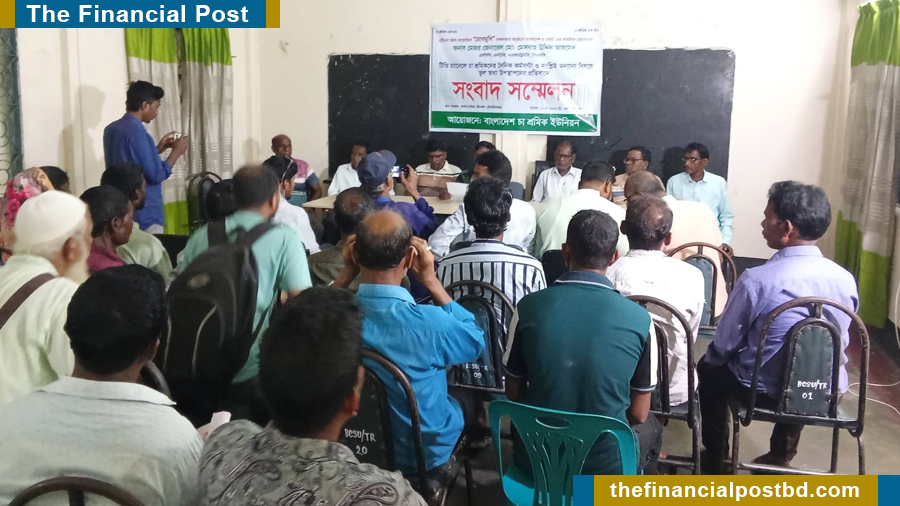
The allegations were raised at a press conference held on Sunday (10 May 2026) afternoon at the auditorium of “Labour House,” the headquarters of the Bangladesh Tea Workers’ Union in Sreemangal, Moulvibazar.
The union’s Acting General Secretary Nripen Pal read out a written statement at the event. Among those present were Treasurer Paresh Kalindi, Balishira Valley President Bijoy Hazra, Executive President Boishishto Tanti, Juri Valley President Kamal Banerjee, Organizing Secretary Kantha Tanti, staff member Dulal Hazra, and leaders of various tea garden panchayets.
In his statement, Nripen Pal said the comments made by the Tea Board chairman on the ATN Bangla Chattogram Center program Mukhomukhi regarding tea workers’ working hours, productivity, and estate management were inconsistent with reality. He alleged that the chairman portrayed workers as not completing full working hours and claimed they worked only three to four hours a day. According to the union, tea workers have long sustained the country’s tea industry through hard labor and dedication.
“Tea workers perform their duties tirelessly every day according to established regulations. Without them, the tea industry would never have reached its current position,” Pal said. “It is deeply unfortunate that the chairman of the Tea Board sided solely with the owners and blamed the workers.”
Pal further said the chairman claimed that many tea estates in the country were operating at a loss and that workers’ unwillingness to work was negatively affecting production. However, the union argued that the reality is different. They pointed to ongoing problems in many tea gardens, including unpaid wages, provident fund dues, poor housing, inadequate healthcare services, and other welfare-related issues. Leaders also alleged that workers in several estates, including the state-owned National Tea Company (NTC), have long faced deprivation and neglect.
The written statement said, “Blaming tea workers while simultaneously taking pride in Bangladesh’s position in the global tea market is contradictory. If workers truly worked only three or four hours a day, how did Bangladesh achieve the eighth position in global tea production?”
Union leaders claimed the chairman’s comments belittled the struggles and sacrifices of tea workers, who they said have been the backbone of the country’s tea industry for nearly two centuries. They described such remarks from a responsible official position as undesirable and harmful to the morale of workers.
At the press conference, the Bangladesh Tea Workers’ Union demanded that the Tea Board chairman withdraw his remarks and apologize to tea workers. The union also urged the government and relevant authorities to ensure workers’ rights, dignity, and welfare.
Responding to questions from journalists, labor leaders said the contribution of tea workers to the country’s tea industry cannot be denied. They noted that workers continue to labor under harsh conditions for very low wages, while basic needs such as healthcare, education, housing, and improved living standards remain largely neglected.
Worker Dissatisfaction and Industry Reality
Union leaders also highlighted that tea workers have staged protests and strikes in recent years demanding wage increases. According to them, wages still do not reflect current market prices and inflation. They added that many tea estates continue to suffer from poor healthcare facilities, inadequate sanitation, unsafe housing, and limited educational opportunities.
They argued that ensuring sustainable development of the tea industry requires meaningful improvements in workers’ living conditions. Blaming workers and spreading negative narratives about them, they said, would not solve the industry’s problems. Instead, they called for coordinated efforts among workers, owners, and the government to secure the long-term development of the tea sector.
Representatives from various print and electronic media outlets attended the press conference. Among them were senior Sreemangal Press Club member, Workers Party of Bangladesh Moulvibazar district leader, RP News editor and columnist Comrade Syed Amiruzzaman; Ekattor TV correspondent Ahmed Faruk Millad; former vice-president of Sreemangal Press Club and Bangladesh Pratidin correspondent Dipankar Bhattacharjee Liton; Prothom Alo correspondent Shimul Torofdar; RTV correspondent Chowdhury Bhaskar Home; Daily Observer correspondent Rupam Acharya; and Rajesh Bhowmik of Dainik Sokaler Khobor, among others.
Reality of Tea Workers Has Been Ignored
Reacting to the issue, former adviser to the Bangladesh Tea Workers’ Union, senior member of Sreemangal Press Club, Workers Party leader, RP News editor, and columnist Comrade Syed Amiruzzaman described the Tea Board chairman’s remarks as “misleading, irresponsible, and insulting to tea workers.”
He said, “The statements made on national television about tea workers are inconsistent with the ground reality. Workers are laboring in inhumane conditions for a daily wage of only Tk 187. In most cases, they must work more than eight hours to meet the required targets.”
He further stated that most tea gardens lack safe working conditions, with inadequate access to clean drinking water, rest areas, and protection from sun and rain.
“Claiming that tea workers are unwilling to work or that their living standards have significantly improved is an attempt to conceal reality,” Amiruzzaman said. “For the greater interest of the country’s tea industry, the chairman of the Bangladesh Tea Board should withdraw his remarks.”
FP/MI