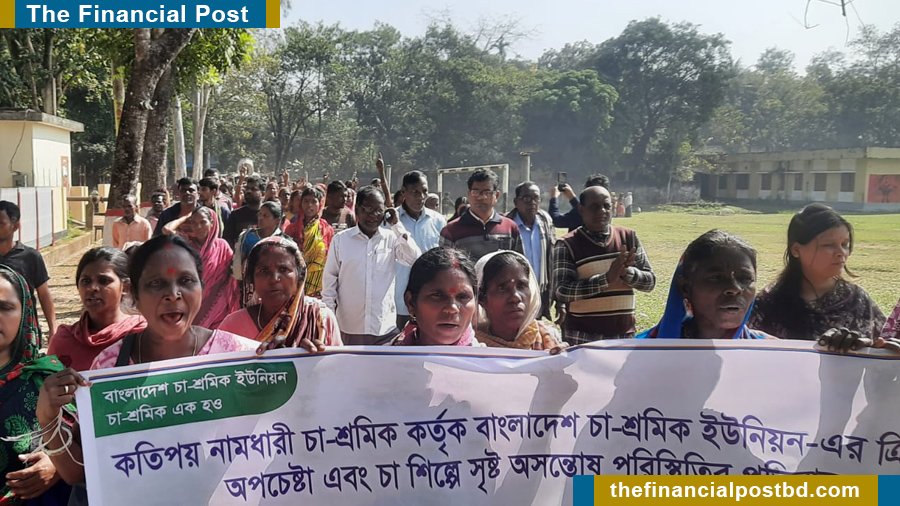
In support of the incumbent committee whose term has expired, a protest march and rally were held in Sreemangal over the election of the Bangladesh Tea Workers’ Union (Bangladesh Cha Sramik Union - BCSU), followed by the submission of a memorandum.
Organised by the Bangladesh Tea Workers’ Union, a special protest march was held in the town, after which a rally took place in front of the Divisional Labour Office in Sreemangal.
The rally, moderated by Dulal Hajra, was addressed by Parag Baroi, former adviser of the Bangladesh Tea Workers’ Union (Bangladesh Cha Sramik Union - BCSU) and former Chairman of Kalighat Union Parishad; Bijoy Hajra, Organising Secretary of the central committee of the Bangladesh Tea Workers’ Union and President of Balishira Valley; Pankaj A. Kanda, Vice-President of the Tea Workers’ Union; Nripen Pal, Acting General Secretary of the Tea Workers’ Union; and Baishishta Tanti, Executive President of the Tea Workers’ Union, among others. Workers from six tea gardens of the Balishira Valley participated in the programmes.
The triennial election of the Bangladesh Tea Workers’ Union (Bangladesh Cha Sramik Union -BCSU) has once again created tension and controversy in the tea industry. On one hand, the current union leadership has submitted memoranda to the highest levels of government, alleging attempts to obstruct the election. On the other hand, a section of the tea worker community has taken to social media, strongly criticising the decision to reconstitute the election commission.
Against this backdrop, questions are being raised about the role of the administration in tea garden–dominated regions, particularly in the context of maintaining worker unity, ensuring industrial stability, and ahead of the upcoming 13th National Parliamentary Election.
Submission of Memorandum: Allegations of Election Sabotage
On Tuesday morning (27 January 2026), leaders of the Bangladesh Tea Workers’ Union submitted a memorandum to the Director General of the Register of Trade Unions through the Deputy Director of the Labour Department. A similar memorandum was submitted to the Deputy Commissioner of Moulvibazar through the Sreemangal Upazila Nirbahi Officer (UNO).
The memorandum alleged deliberate attempts to sabotage the election and to create artificial instability in the tea industry.
It stated that the last election of the Bangladesh Tea Workers’ Union was held in 2021. In accordance with the union constitution, the leadership has been maintaining regular communication with the Ministry of Labour and Employment and the Department of Labour to arrange elections after the expiry of the committee’s tenure.
Union leaders said that at a meeting held on 21 September 2025, chaired by the Secretary of the Ministry of Labour and Employment, Dr Md Sanowar Jahan Bhuiyan, a decision was taken to hold the election by December 2025.
However, due to the country’s recent political situation and directives from the Election Commission, the election was postponed.
In this situation, the memorandum alleged that certain unruly individuals, acting outside the union constitution, are attempting to disrupt the election process by demanding the formation of an ad hoc committee.
Sit-in Programme and Rising Tensions
The memorandum further mentioned that on 18 January, a sit-in programme was organised in front of the Divisional Labour Office in Sreemangal under the leadership of a few individuals. According to the union, a large portion of the participants in that programme were not legitimate subscription-paying members of the union.
The union claimed that such activities are creating confusion among tea workers and are aimed at damaging the image of the government. In this context, the memorandum called for administrative intervention to maintain a peaceful environment and ensure the continuation of normal activities in the tea industry.
To facilitate the triennial election of the Bangladesh Tea Workers’ Union (Registration No. B-77), the government has reconstituted a nine-member election commission. The reconstituted commission is headed by Mahabbat Hossain, Deputy Director of the Divisional Labour Office, and includes government officials as well as representatives from various tea gardens.
Other members of the election commission include Abir Chandra Bala, Deputy Director of the Regional Labour Office; Md Abdus Sabbir Bhuiyan, Assistant Director of the Divisional Labour Office; and tea garden representatives Mani Shankar Bauri (Deundi Tea Garden), Dipen Banerjee (Phultala), Manjus Tanti (Rajghat), Md Kawsar Ahmed (Patrokhola), Santosh Lohar (Bharoura), and Mahesh Roy (Tarapasha Tea Garden).
According to the Department of Labour, the commission has been reconstituted in line with Article 09 (Ja) of the union constitution, the Bangladesh Labour Act 2006, the Labour Rules 2015, and directives issued by the Supreme Court in Writ Petition Nos. 7372/2011 and 4316/2016.
The office order confirming the reconstitution of the commission was signed by A K M Tarikul Alam, Director General of the Trade Union Wing of the Department of Labour, and countersigned by Director Shamima Sultana Bari.
The order stated, “The commission has been formed to ensure that the triennial election is conducted freely, fairly, and transparently. Necessary expenses will be borne from the Bangladesh Tea Workers’ Union fund through the commission.”
Copies of the order have been sent to the Deputy Commissioners (DCs) and Superintendents of Police (SPs) of Moulvibazar, Habiganj, Sylhet, Chattogram, and Rangamati districts; the Private Secretary to the Secretary of the Ministry of Labour; the Bangladesh Tea Association (the organisation of tea garden owners); and concerned labour officials.
Origin of the Controversy: Questions of Acceptability
The reconstitution of the election commission has already sparked criticism and debate on social media.
Gita Rani Kanu, one of the prominent young and female leaders of the tea worker community, wrote in a Facebook post:
“The election commission of the Tea Workers’ Union reconstituted by the Labour Department is in no way acceptable. This has been done in violation of the Honourable High Court’s order, with the intention of organising a sham election so that corrupt leadership can return to power and the owners can continue the process of exploiting workers.”
She further claimed, “An interim committee should be formed, and elections should be held after amending the constitution. Otherwise, legal action and movements will be inevitable.”
Counter-Reaction: Timely Election Is Essential
In contrast, former General Secretary of the Bangladesh Tea Workers’ Union, Ram Bhajan Kairi, welcomed the decision to reconstitute the election commission, calling it “long overdue,” in a Facebook post. He wrote, “I welcome and congratulate the Bachashramik Union Election Commission. I hope the commission will conduct the election in accordance with the constitution and strengthen the organisation of tea workers.”
Commenting on the issue, Comrade Syed Amiruzzaman—member of the editorial board of the Workers Party of Bangladesh, Moulvibazar district; researcher on the Liberation War; correspondent of the English daily The Financial Post and the weekly Natun Katha; editor of RP News; and a noted columnist—welcomed the reconstitution of the nine-member election commission in line with Article 09 (Ja) of the existing constitution for holding the triennial election of the Bangladesh Tea Workers’ Union (Registration No. B-77).
He said, “Holding the Tea Workers’ Union election on time is extremely important. This is not only a matter of maintaining democratic continuity within the organisation, but also a means of raising organised demands for fair wages, social security, land rights, and a dignified life for tea workers.”
He further stated that eliminating discrimination in the tea industry, determining fair wages for tea workers, raising and negotiating workers’ demands, ensuring land rights, social security, and a dignified and humane life—all require a strong union. Therefore, ensuring the timely election of the Bangladesh Tea Workers’ Union is essential and cannot be ignored or denied on any other pretext.
He added, “There is no alternative to elections in order to ensure accountability in worker leadership and to enhance bargaining power with owners and the state.”
Legal and Constitutional Perspective
According to experts, the Bangladesh Labour Act 2006 and the Labour Rules 2015 require that elections of any trade union be completed “within the time specified in the constitution.”
In the case of the Tea Workers’ Union, elections have been delayed several times in the past, raising questions about the legitimacy of its leadership.
On the other hand, High Court verdicts (Writ Nos. 7372/2011 and 4316/2016) state that while administrative supervision in forming a trade union election commission is lawful, “the distinctiveness of worker representation must be preserved.” In this context, questions have been raised about the numerical dominance of government officials in the new commission.
Context of the Tea Industry
Bangladesh has around 150,000 registered tea workers and several hundred thousand temporary workers employed in this centuries-old industry. Most of them work in more than 160 tea gardens across Sylhet, Moulvibazar, and Habiganj districts.
Despite their contribution to export earnings, long-standing dissatisfaction persists over minimum wages, social security, and housing standards for tea workers.
Union leadership plays a key role in placing these demands before the state and the owners. Therefore, the union election is not merely about leadership change; it significantly influences the trajectory of labour politics in the tea sector.
Theoretical Analysis: Labour Politics, Conflict, and Democratic Reconstruction
According to labour movement theory, trade union democracy is not limited to electing leaders through voting; it is also a process of defining organisational values, ideology, and empowering workers.
When union elections are delayed, a “crisis of representation” emerges, which weakens the labour movement.
However, forming an election commission dependent on the Ministry of Labour can raise questions about transparency and independence—an issue long debated in labour politics. Workers demand a commission that is worker-led, autonomous, and participatory, while the government insists that elections must be conducted within the legal framework and under administrative supervision.
The conflict between these two perspectives has turned the Tea Workers’ Union election into a “testing ground of labour politics.”
Conclusion
The reconstitution of the Bangladesh Tea Workers’ Union election commission is undoubtedly a timely step. However, its acceptability will depend on the commission’s neutrality, transparency, and the level of trust it inspires among the worker community.
The tea workers’ organisation is not merely an industrial entity; it is a symbol of a historic labour movement. The controversies and reactions surrounding this election therefore point toward the future direction of democratic practice in Bangladesh’s labour politics.
FP/MI





 Seven more children die with measles symptoms
 Four die while rescuing goat from abandoned pit in Tangail
 Bangladeshi hockey legend Abdus Sadeque passes away
 Actor Alvi sent to jail upon surrender in case over wife’s death
 EU extends €14m support for Rohingya refugees in Bangladesh
 SSC results to be published on 20 July: Education Minister
 Bangladeshi funds in Swiss banks jump 42% in 2025
 Gold prices rise again