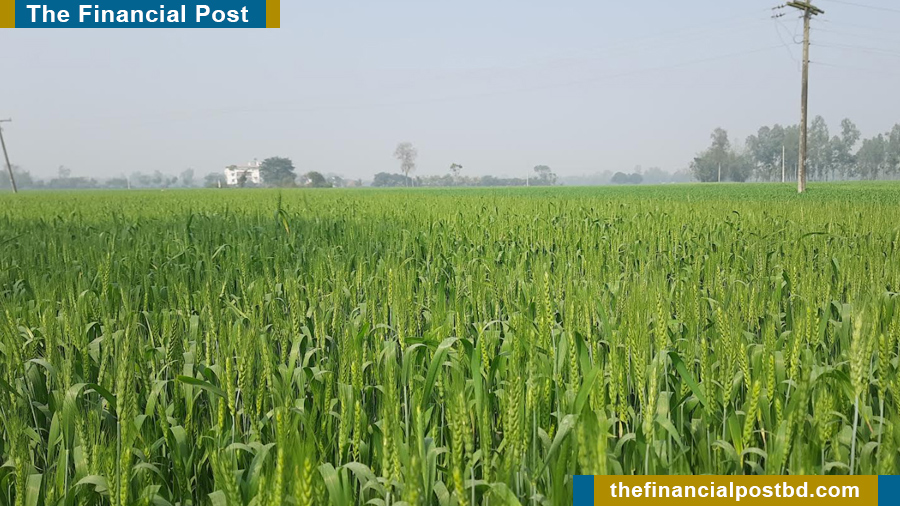
Farmers in Thakurgaon are gradually losing interest in wheat cultivation due to widespread corruption and misuse of government incentive programs. Although the Department of Agricultural Extension organizes courtyard meetings, demonstrations, and provides seed and fertilizer support to encourage wheat farming, the cultivated land under wheat in the district has been declining at an alarming rate every year.
Over the last five seasons, wheat cultivation area in the district has decreased by 25,950 hectares. Farmers claim that the seed and fertilizer incentives promised by the agriculture department exist only on paper. Despite repeatedly approaching Sub-Assistant Agriculture Officers, local political leaders, and union members and chairmen, genuine farmers are often deprived of these benefits, while preferred individuals receive them in exchange for money.
As a result, many farmers are shifting to crops like maize and mustard, which require lower production costs and generate higher profits than wheat. According to data from the Thakurgaon district office of the Department of Agricultural Extension, wheat was cultivated on 50,650 hectares in the 2019–20 season, with a total production of 207,685 tonnes. This has continuously declined, and in the 2024–25 season, cultivation dropped to 21,050 hectares, with production falling to only 83,608 tonnes.
For the current 2025–26 Rabi season, the target has been set at 31,500 hectares with an expected production of 126,945 tonnes. However, by the beginning of December, planting had been completed on only 4,670 hectares.
Farmer Nuruzzaman Lemon from Madhya Jhargaon village of Akhanagar Union in Sadar Upazila said, "Looting continues in the name of incentives. Instead of giving support to real farmers, Sub-Assistant Agriculture Officers and political leaders select beneficiaries of their own choice in exchange for money. Moreover, wheat requires a long winter, which we no longer get. Good quality seeds are not available, labor is scarce, and profits are low."
Another farmer from the same area, Nawab, said, "It is impossible to receive incentives without paying brokers and Sub-Assistant Agriculture Officers. Those who received seeds and fertilizer in exchange for money do not even cultivate wheat. The incentive seeds and fertilizers are sold openly in the market. Maize requires less irrigation and care, costs less, and yields 40–45 maunds per bigha, while wheat yields only 13–14 maunds. The price of maize is also better, which is why I have been shifting to maize for several years."
Shafiqul Islam from Chilarang Union of Sadar Upazila said he previously cultivated wheat on 10 bighas of land but has now completely switched to maize. "Maize brings more than double the profit compared to the cost per bigha. Wheat carries the risk of losses. I ran after Sub-Assistant Agriculture Officers and chairmen for days for incentives but did not receive any. Those who got them sold the inputs in the market for money."
From Amgaon Union of Haripur Upazila, farmer Ziaur Rahman made similar allegations, saying, "Those whose names were included in the incentive lists got them by paying money. I used to cultivate wheat on five to six bighas, but now I don't cultivate even one bigha. All my land is under maize."
When asked, Nasirul Alam, Agriculture Officer of Thakurgaon Sadar Upazila, denied knowledge of any irregularities in the distribution of incentives. He said that the number of fish, livestock, and poultry farms in the district has increased significantly, raising the demand for maize for animal feed. This, he said, has encouraged farmers to shift towards maize. He added that maize incentives have now been stopped and wheat incentives have been increased. In the current season, 27,500 farmers have been provided with 20 kg of seed and 20 kg of fertilizer each for 27,500 bighas of land.
Meanwhile, Md. Mazedul Islam, Deputy Director of the Department of Agricultural Extension in Thakurgaon, tactfully avoided the issue of corruption and said, "Farmers are moving towards more profitable crops. Instead of wheat, they are leaning towards maize and mustard. Still, we are trying to increase wheat cultivation. The amount of incentives has also been increased."
However, farmers continue to insist that if incentives were given to genuine cultivators instead of fake beneficiaries, the targets could have been achieved. Prominent social thinker and columnist Azmat Rana said that although incentives for seeds and fertilizers are claimed to be provided to farmers, real farmers do not receive them. Thakurgaon was once among the top three wheat-producing districts in the country, but due to a corruption syndicate involving some Sub-Assistant Agriculture Officers, local representatives, and union-level political leaders, farmers are losing interest in wheat cultivation. Local farmers believe that breaking this corrupt cycle and ensuring incentives reach genuine farmers would restore wheat cultivation in Thakurgaon to its former level.
FP/MI