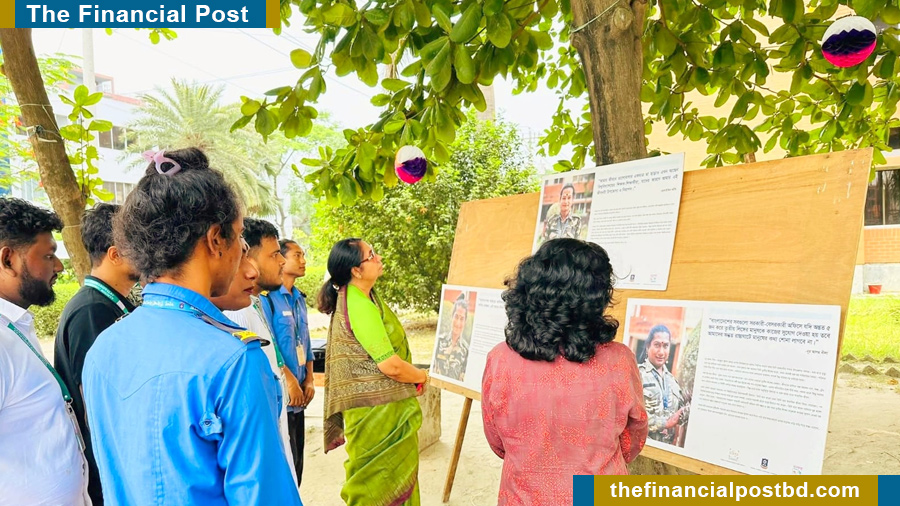
On most days, a university campus moves to a familiar rhythm. Faces pass by without pause, duties are performed without notice, and stories remain tucked behind routine. At Gono Bishwabidyalay in Savar, that quiet routine was gently interrupted by a two day photography exhibition that asked viewers to look again and look deeper.
Titled “Tritiyo Chokhe Onno Jibon”, the fourth annual exhibition by the Gono Bishwabidyalay Photographic Society transformed the Badamtala premises into a contemplative gallery of lives that are often seen, yet rarely understood. The images did not merely occupy walls. They lingered, inviting visitors to pause, to read expressions, and to recognise the weight of lived experience within each frame.
The exhibition opened on Sunday morning, April 26, with Professor Nilufar Sultana, Dean of the Faculty of Arts and Social Sciences, inaugurating the event. As she moved slowly from one photograph to another, her attention settled on a striking image of a third gender security staff member standing at the campus gate. The surrounding blur of movement contrasted with the subject’s stillness, her gaze carrying both resolve and solitude. Reflecting on the moment, the dean remarked that while such individuals are seen every day, it is only through such efforts that they are truly felt.
The centre of the exhibition was a series portraying six third gender security personnel employed by the university since 2018, an initiative widely recognised as a pioneering step in Bangladesh’s higher education landscape. Through carefully composed visuals, the exhibition traced their journeys not as a singular narrative of identity, but as layered human experiences shaped by resilience, dignity and the pursuit of acceptance.
One photograph captured the quiet determination of an early morning shift, soft light falling across a face that held both fatigue and hope. Another depicted an afternoon break shared with colleagues, where laughter momentarily softened the edges of a demanding routine. In a particularly evocative frame, a staff member stood beneath a rain soaked sky, an umbrella in hand, her silhouette blending into the blurred backdrop of the campus. The image seemed to echo a deeper metaphor of endurance amid uncertainty.
Visitors moved through the exhibition in thoughtful silence, often breaking into hushed conversations. Some admitted that they had long observed these individuals only through the lens of their roles, without ever considering the person behind the uniform. Others lingered quietly, allowing the images to settle within them.
A student, visibly moved, noted that the photographs carried a certain discomfort, yet that very discomfort nurtured empathy. It suggested a need to shift perspective, to see beyond labels and into lived realities.
According to Nazmul Muktadir Saimum, president of the society, the project was rooted in time spent with the subjects themselves. Photographers listened to their stories, shared moments of their daily lives, and attempted to translate that intimacy into visual narratives. The intention, he explained, was not simply to document, but to humanise, to allow viewers to encounter these individuals outside the confines of identity and occupation.
The initiative was supported by the university’s Department of Sociology and Social Work, with a public health themed photography project serving as the technical partner. Together, they ensured that the exhibition maintained both artistic integrity and social relevance.
At its core, the exhibition resonated with the inclusive philosophy of Dr. Zafrullah Chowdhury, whose vision emphasised dignity, equity and the fundamental worth of every individual. The images echoed that ethos, quietly challenging viewers to reconsider their own perceptions and biases.
As Monday afternoon drew to a close, the exhibition came to an end. The walls of Badamtala gradually returned to their usual stillness. Yet the impressions left behind were far from fleeting. Visitors departed not only with photographs captured on their phones, but with a renewed awareness carried within.
FP/MI


 Third eye, fuller truths: Framing lives often left unseen
 Chattogram port keeps national economy afloat for 139 years
 Who is Hisham Abugharbeih, in custody over Bangladeshi student’s death in US?
 Historical Insights for River and Canal Restoration in BNP’s 2026 Manifesto
 Over 1.35 lakh SSC candidates face uncertain futures over late syllabus changes


 Country’s people cannot be held back by scare tactics: PM
 Five more children die of measles, symptoms in 24hrs
 Crackdown on drugs, online gambling after Apr 30: Salahuddin