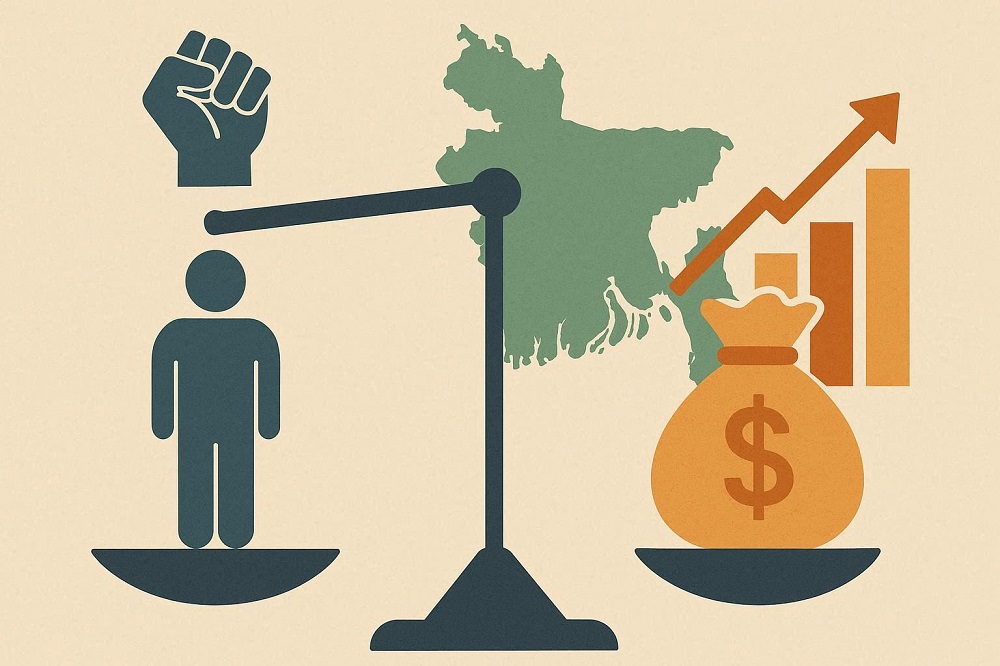
Bangladesh’s interim government, led by Chief Adviser Muhammad Yunus, faces a burden almost too great to bear: steering a nation weary of entrenched political instability, corruption, and systemic human rights abuses toward genuine democracy. The objective is not just a return to basic order, but the creation of a fundamentally more just and prosperous society. Crucially, as Dhaka seeks to re-establish vital trade relationships and attract foreign capital, this commitment to reform is being tested by a toxic and persistent pattern of arbitrary arrests. This pattern - where judicial and administrative powers appear weaponized against critics - carries direct, serious, and quantifiable economic consequences that threaten to derail the entire recovery mission.
The plight of journalist couple Farzana Rupa and Shakil Ahmed is one prominent example. Since their arrest last year on August 21, 2024, they have remained imprisoned, facing multiple murder charges stemming from the July Uprising that are widely viewed as politically motivated reprisals for their journalism. They are not alone. International human rights organizations confirm that Rupa and Shakil are among hundreds of journalists, lawyers, human rights defenders, or celebrities who face murder charges or have experienced abrupt termination of contracts or the loss of press accreditation and smear campaigns. This aggressive crackdown on dissent signals that judicial and administrative powers are being weaponized, raising immediate red flags for the global community.
The Economic and Geopolitical Tax
This institutional failure is not merely a domestic political matter; it directly translates into economic pain. As a nation heavily reliant on the Ready-Made Garment (RMG) sector and dependent on both Foreign Direct Investment (FDI) and Official Development Assistance (ODA), Bangladesh's stability is inextricably linked to its international credibility.
1. Trade Conditionality: The Cost of Market Access
Bangladesh’s two largest markets, the United States and the European Union, have codified the link between trade access and adherence to human rights standards.
The U.S. Factor: Washington has consistently used trade policy as a lever for human rights, a principle now central to bilateral relations. While Dhaka is actively negotiating for more favorable trade conditions - including a target tariff rate of 15% - the pursuit of these economic gains is fundamentally conditional. When respected journalists are detained without due process, it signals a failure to embrace true reform. This severely weakens the interim government's negotiating leverage and fuels arguments in the U.S. Congress for the imposition of stricter, rights-based trade conditions, potentially leading to sanctions or the suspension of trade benefits that support millions of jobs.
The EU’s GSP+ Mechanism: The market access provided by the EU is essential, yet it is conditioned under the Generalized Scheme of Preferences Plus (GSP+) status. To maintain this status, Bangladesh must demonstrate effective implementation of 27 international conventions, including core International Labour Organization (ILO) standards and conventions on civil and political rights. A documented pattern of arbitrary arrests puts this incredibly valuable trade status - vital for a sector responsible for over 80% of export earnings - at immediate risk of review or revocation. Losing this preferential access would be catastrophic for the national economy.
2. The Erosion of Investor Confidence (FDI)
For businesses, legal predictability is currency. The legal system’s integrity was already tenuous, having been widely criticized during the preceding Awami League era. The continued use of arbitrary arrests, even when directed at former political figures and their supporters, suggests instability and legal unpredictability, creating systemic risks that deter both foreign and domestic capital. When the legal system is seen as subservient to political will, it signals to international investors that commercial risk is unmanageable. Capital cannot flow freely where there is doubt that contracts will be enforced, that intellectual property will be protected, or that assets will be secure against political interference. FDI dries up when investors lose trust in the impartiality of the state.
This uncertainty generates direct financial consequences, including higher insurance premiums and a greater cost of capital for businesses operating in Bangladesh, making the nation less competitive than regional rivals. Furthermore, the persecution of civil society leaders and journalists contributes to a long-term talent drain, forcing skilled professionals to seek safer work environments abroad. This erosion of the professional middle class diminishes the domestic expertise needed to transition to higher-value industries. Arbitrary detentions are therefore viewed by international finance institutions and sovereign wealth funds as a “litmus test for legal predictability” - a test Bangladesh is currently failing.
The Institutional Imperative
The persecution of journalists and lawyers - the very groups essential for public accountability - is seen by the IMF, World Bank, and UN as a failure to meet governance metrics. This compromises the government's ability to unlock crucial development financing and makes the delivery of foreign aid (ODA) less efficient and less transparent. A government seen as actively suppressing accountability measures will face greater scrutiny and potentially more punitive conditions on future disbursements.
The interim government must recognize that human rights are not a secondary, peripheral concern; they are fundamental and foundational to economic prosperity. Critically, these rights are universal, extending to every citizen regardless of their political affiliation or whether they are perceived by the state as a legitimate opponent. The practice of leveling fabricated charges, such as murder, to silence dissent and justify imprisonment constitutes a dangerous escalation into lawfare. Accepting such abuses of the legal system signals that the judiciary remains subservient to political objectives, profoundly jeopardizing the credibility of the entire reform effort.
Releasing journalists like Farzana Rupa and Shakil Ahmed, and ensuring fair, transparent legal processes for all political prisoners, is not just the moral choice. It is an essential economic strategy. The government must demonstrate that the era of weaponizing the state apparatus is over.
A government that protects its critical voices strengthens its credibility abroad and gains the necessary leverage to negotiate successfully for its people on the world stage. The path to global prosperity for Bangladesh starts with domestic justice and the protection of its own citizens.




 Hasina can’t evade responsibility for Khaleda Zia’s death: Nazrul
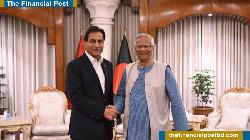 Pakistan’s National Assembly speaker calls on chief adviser
 Three service chiefs attend Khaleda Zia’s janaza
 Farewell to a leader; Khaleda Zia laid to rest with state honour
 Highest 18 candidates file nominations in Dhaka-12, Gazipur-2
 Mirza Fakhrul submits nomination for Thakurgaon-1
 Artistes mourn the passing of Khaleda Zia
 Khaleda Zia’s janaza held with tears of lakhs of mourners
 Rumeen Farhana, Nirob among nine BNP leaders expelled