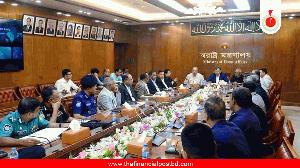
Home Minister Salahuddin Ahmed has called for modern, integrated and technology-driven border management to strengthen national security, facilitate international trade and accelerate Bangladesh's economic growth.
"Modern, integrated, and technology-based safe border management plays an essential role in consolidating national security as well as achieving the country's economic growth," he said.
He added, "Today, in the global context, Bangladesh is more connected with the outside world than at any other time. Under these circumstances, while facilitating international travel and trade, the government is working uninterruptedly to build a technology-driven and international-standard immigration system to tackle cross-border risks."
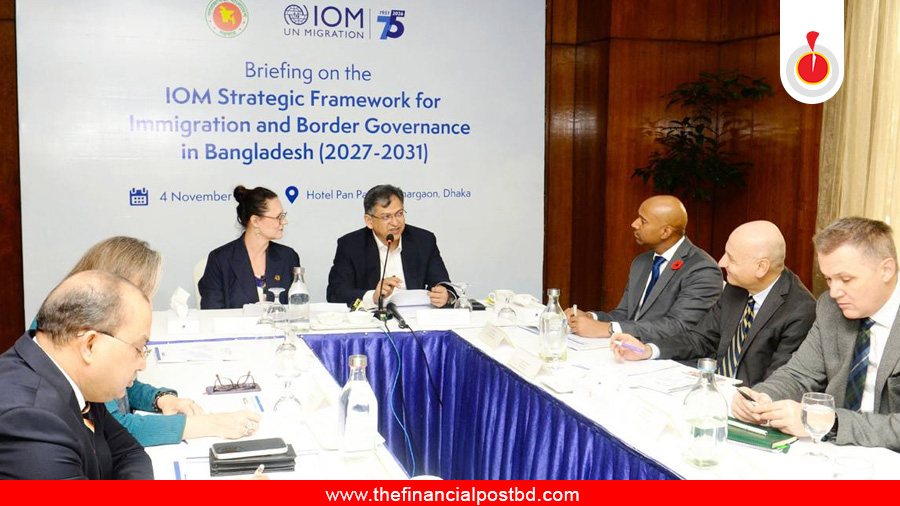
The minister made the remarks on Wednesday as the chief guest at a briefing on the 'IOM Strategic Framework on Immigration and Border Governance in Bangladesh (2027–2031)' at Hotel Pan Pacific Sonargaon in Dhaka. The event was organised by the International Organization for Migration (IOM).
Salahuddin said border management must balance national security with the facilitation of legitimate travel and trade.
Highlighting the government's 'National Integrated Border Management Strategy 2026–2031' and 'Five-Year Strategic Reform and Development Framework 2026–2031', he said digital transformation, responsible use of artificial intelligence, paperless administrative operations and greater interoperability among public services were key priorities.
Emphasising the role of the Special Branch of Bangladesh Police in immigration management, he said, "Through the combination of policy and modern technology, the operational capacity of our airports, land ports, and immigration checkpoints must be multiplied manifold."
He also stressed that border management should not rely solely on technology but must meet professional standards while respecting human rights and protection principles.
Calling for stronger coordination among ministries, departments and law enforcement agencies to combat transnational crime, human trafficking and irregular migration, the minister said, "Border management is not the responsibility of a single agency. For this, joint efforts of all relevant ministries, departments, and law enforcement agencies are required."
Salahuddin welcomed IOM's proposed strategic framework for 2027–2031 and urged the organisation to continue supporting the development of international-standard border infrastructure in Bangladesh.
He also called on development partners to increase technical and financial assistance.
"International investment will not only secure Bangladesh's borders, but will also make a major contribution to regional stability and safe globalization," he said.
Speaking at the event, IOM Bangladesh Chief of Mission Dr. Laura Tom Bonde said Bangladesh had made significant progress in strengthening its migration and border management capacity.
"As travel patterns and operational needs change, the need for effective measures, skilled manpower, and better coordination among relevant agencies will increase. IOM is eager to cooperate through technical expertise and partnership in implementing the government's priorities," she said.
Additional Secretary of the Political and Immigration Division of the Ministry of Home Affairs Dr. Ziauddin Ahmed, Joint Secretary of the Political-1 Branch Rebecca Khan, Special Branch Additional Inspector General of Police Md. Kamrul Ahsan and Deputy Inspector General of Police Md. Moazzem Hossain attended the event.
Canadian High Commissioner to Bangladesh Ajit Singh and Italy's Ambassador to Bangladesh Antonio Alessandro also attended, along with representatives of various development partner organisations.
Participants discussed ways to address human trafficking, cross-border crime and identity fraud while facilitating legitimate international travel and trade.
The proposed strategic framework identified four potential areas of cooperation: integrated border management; digital systems and data sharing; institutional and professional capacity development; and infrastructure and service improvements at selected border points.
The framework also took into account the government's Five-Year Strategic Reform and Development Framework covering July 2026 to June 2031.
FP/A