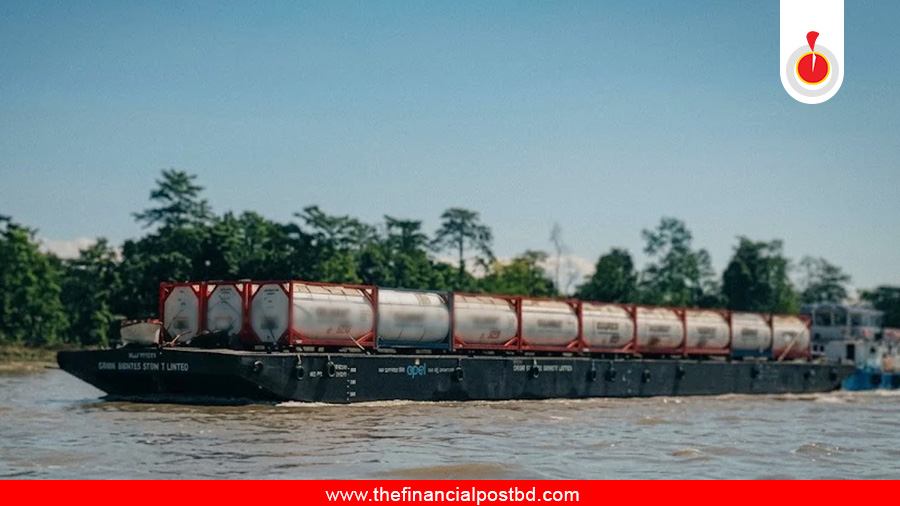
A barge carrying 540 metric tonnes of methanol has left Bogibeel terminal in Assam’s Dibrugarh for Dhaka, marking the first cargo shipment from Upper Assam to a foreign port since India gained independence in 1947.
Union Minister for Ports, Shipping and Waterways Sarbananda Sonowal flagged off the vessel on Monday in the presence of ministers, MPs and MLAs. Assam Chief Minister Himanta Biswa Sarma joined the event virtually.
The methanol, produced by state-owned Assam Petro-Chemicals Ltd (APCL) at Namrup, is headed for Pangaon Port in Dhaka.
The vessel will travel about 768 kilometres along National Waterway-2 on the Brahmaputra before reaching the India-Bangladesh border. From there, it will continue through the Indo-Bangladesh Protocol Route (IBPR).
The full journey from Bogibeel to Narayanganj in Dhaka will be around 1,300 kilometres.
The trip is also being watched closely as a test of whether the Brahmaputra can once again become a practical freight route for Assam and the wider Northeast to reach overseas markets through Bangladesh.
“Our grandparents grew up hearing the steamer whistle at Dibrugarh Ghat. For 70 years, that whistle fell silent and the ships stopped coming,” Sonowal said.
“Today, a ship leaves Dibrugarh for the world once again. The river never failed us. What it lacked for decades was the will to revive it,” he said.
“Assam’s own product, made in Namrup, is now travelling to an international market on Assam’s own river. The Northeast is no longer a frontier. It is India’s gateway to the East,” Sonowal said.
He described the shipment as a beginning, adding, “This is the first voyage, not the last.”
Sarma also described the occasion as a proud day for Assam.
Dibrugarh once had a busy river port and was an important link in the region’s trade. Government steamers were reaching the town from Calcutta, now Kolkata, by 1856. The Dibru-Sadiya Railway began operating from the Dibrugarh steamer ghat in 1882.
By 1913, steamers were making daily trips up the Brahmaputra to Dibrugarh, carrying tea, timber and passengers.
That river connection was disrupted by the 1947 Partition. Assam’s goods had to pass through East Pakistan to reach Calcutta. Then, in 1950, an earthquake changed the riverbed around Dibrugarh.
Regular bookings from Dibrugarh Ghat stopped in 1954, and the ghat finally closed on October 15, 1956, as tea shipments increasingly moved by rail.
The 1965 India-Pakistan war brought another halt to cross-border river trade.
India and Bangladesh signed a river trade protocol in 1972. In 1988, an 891-kilometre stretch of the Brahmaputra, from Sadiya to Dhubri, was declared National Waterway-2.
Regular cargo services, however, took much longer to return. They began in December 2017, when cement was transported from Pandu to Dhubri.
“For decades, that glory was allowed to fade. Under the leadership of Prime Minister Narendra Modi ji, we set out to give Dibrugarh back its rightful place,” Sonowal said.
“The Bogibeel terminal, the customs and immigration complex and fixed-schedule cargo services under ‘Jalvahak’ are giving this historic town modern amenities and world-class infrastructure,” he added.
“We are building for the future while reinstating the heritage that made Dibrugarh great. Today, as cargo leaves Dibrugarh for a foreign port once again, the town’s proud past and its promising future meet on the same river.”
There has been growing activity along the route in recent years. Tata Steel barges travelled to Pandu through Bangladesh in February 2022, while the river cruise ship MV Ganga Vilas made its journey from Varanasi to Dibrugarh through Bangladesh in 2023.
The Bogibeel passenger and cargo terminal, for which the foundation stone was laid in July 2023, opened in February 2024. The ‘Jalvahak’ cargo incentive programme followed in December 2024.
According to the Ministry of Ports, Shipping and Waterways, cargo movement on India’s national waterways rose from 18 million metric tonnes in fiscal 2013-14 to 218 million metric tonnes in 2025-26.
More than Rs68 billion (about $770 million) is being invested in waterways across the Northeast. The projects include the development of National Waterway-2, a ship repair facility at Pandu and last-mile connectivity to Pandu Port.
“Every tonne we move on the river means less fuel burnt and fewer trucks on the highway,” Sonowal said.
He also said India was working with Bangladesh, Nepal, Bhutan and Myanmar on regional waterway links.
The voyage involves the Inland Waterways Authority of India, Assam Petro-Chemicals, Cochin Bunkers Pvt Ltd and partners in Bangladesh.
FP/A