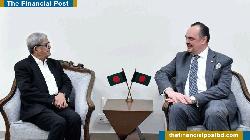
The government has intensified preparations to send huge numbers of skilled manpower to Japan under the Specified Skilled Worker (SSW) category, as Japan faces an ongoing shortage of qualified manpower.
The Japanese government has set a target to recruit 8.20 lakh foreign workers across 16 sectors under the SSW category by March 2029.
Experts and officials believe that if Bangladesh prepares effectively, it can supply up to 40 percent of this demand that is more than 300,000 workers.
Previously, Bangladesh had the capacity to send workers in only six of these categories. Now, the government is working to develop skilled manpower for all 16 categories.
Professor Dr. Md. Jahangir Alam, Chairman of the Japanese Studies Department at Dhaka University described Japan as an attractive destination for Bangladeshi workers.
He said with proper focus on skill development, Bangladesh can meet a substantial portion of Japan’s labour demand, boosting foreign currency earnings.
Citing a report recently published in The Japan Times, the labour welfare wing of the Bangladesh Embassy in Tokyo stated that Japan aims to recruit around 1.2 million (12 lakh) foreign workers under both the Employment Skill Development (ESD) and SSW categories by March 2029.
Long-term projections suggest that Japan may require up to 11 million (1.1 crore) foreign workers by 2040.
Professor Jahangir stressed the importance on Japanese language proficiency and familiarity with advanced technologies before migration to Japan.
He noted that gaining trust in Japanese society would open more opportunities for Bangladeshi workers in the future. If conditions are met, Bangladesh can potentially supply 50 to 60 percent of Japan’s labour demand by 2040.
To support this goal, the government has adopted comprehensive short, medium, and long-term plans.
These include improving the quality of Japanese language training centers, enhancing trainer capacity, bringing language instructors from Japan, establishing special economic zones for skill training and expanding training programs across the country.
Efforts are also underway to upgrade Technical Training Centers (TTCs) under the Bureau of Manpower, Employment and Training (BMET) to Japanese standards through agreements with Japanese institutions.
Currently, the Japanese language training is offered in 53 TTCs, with hybrid (online) training available in 15 centers.
Additionally, more than 200 private language institutes are operating nationwide. Bangladesh has now 95 approved recruiting agencies authorized by Japan, according to available statistics.
Government Focus on Japan:
To remain competitive with countries like Nepal, Vietnam and Indonesia, Bangladesh has increased its focus on the Japanese labour market.
The government has taken several institutional measures including appointing a high-level adviser in the Ministry of Expatriates’ Welfare and Overseas Employment and a special assistant dedicated to expand employment opportunities to Japan and the Asia-Pacific region.
A dedicated “Japan Cell” has been established within the ministry, with plans to strengthen its organizational structure, recruit personnel and launch a separate website.
The Bangladesh Embassy in Tokyo has also been reinforced with additional staffs, including a consular officer, support personnel and Japanese nationals to better understand local demand and facilitate the employment opportunities.
Student Migration and Financial Support:
The government is also promoting student migration. While 4,000 Bangladeshi students went to Japan on student visas in 2025, the target for 2026 has been set at 10,000.
To support this, the Probashi Kallyan Bank is offering loans of up to Taka one million (10 Lakh) per student on easy terms.
Students in Japan are allowed to work more than 28 hours per week.
Additionally, the requirement for manpower agencies to deposit Taka 1.5 million (15 lakh) has been waived to simplify the process.
Deputy Secretary Md. Hedayetul Islam Mondol of the Ministry of Expatriates’ Welfare and Overseas Employment said Bangladesh has taken various pragmatic steps to send Bangladeshi manpower to Japan’s labour market.
These measures included strengthening bilateral engagement, taking training initiative, making easier loan facilities, streamlining payments of frees through banking channel and revised guidelines in this regard.
He said these initiatives have helped turn Japan into a major employment destination for Bangladeshi workers.
Japan ranks highly in human resource development and offers foreign workers due to its favorable social status, access to services and attractive income opportunities.
The government through the Japan Cell and relevant ministries is working to ensure that Bangladeshi workers are well-trained in both skills and in terms of language proficiency before being sent to abroad.
FP/MI



 Govt taking steps to modernise coast guard: Home Minister
 No alternative to ensuring justice for all to consolidate democratic journey: PM
 Govt to take strong stance against misinformation, disinformation: Adviser Zahed
 SC upholds bail for ex-chief justice Khairul Haque in five cases
 Society Before the Digital Mirror: Rethinking the Power, Impact, and Responsibility of Social Media
  Third eye, fuller truths: Framing lives often left unseen
 Who is Hisham Abugharbeih, in custody over Bangladeshi student’s death in US?
 Chattogram port keeps national economy afloat for 139 years
 Sick Economy: Why Bangladesh Can’t Afford a Weak Health System