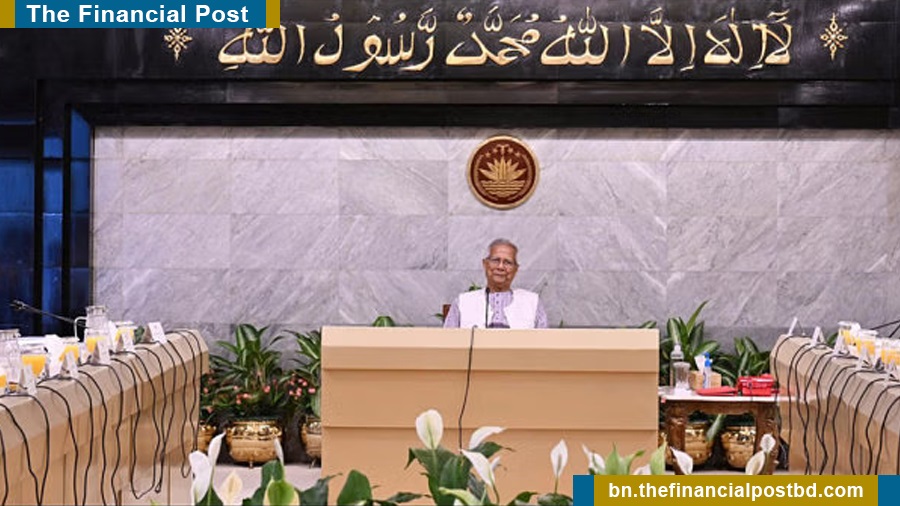
In a significant policy shift, Bangladesh's interim government has decided to abolish the provision in the Public Service Act, 2018, that allowed the forced retirement of public servants after 25 years of service. This decision was made during the 29th meeting of the Advisory Council, chaired by Chief Adviser Prof Muhammad Yunus, at the Chief Adviser’s Office in Tejgaon, Dhaka.
The abolished provision had permitted the government to retire any public servant without providing justification, provided they had completed 25 years of service. While employees were entitled to full retirement benefits under this clause, it faced widespread criticism for enabling arbitrary dismissals. The Public Administration Reform Commission had earlier recommended its repeal, and the Advisory Council has now directed its abolition.
In addition to this move, the Advisory Council approved the draft of the "Public Service (Amendment) Ordinance, 2025," which introduces stricter disciplinary measures for government employees. The proposed ordinance allows for the dismissal of employees without an inquiry for offenses such as unauthorized absence, inciting disobedience among colleagues, or obstructing duties. Initially, the process involved issuing two notices with five-day and three-day deadlines, respectively. However, the Advisory Council has recommended extending the notice periods to two phases of seven working days each, totaling 14 working days.
The draft ordinance has raised concerns among public servants and employee associations. The Inter-Ministerial Employees’ Association has urged the Chief Adviser to reconsider the draft, citing potential constitutional violations and threats to the freedom of thought and conscience of public employees. On Thursday, a number of public servants staged a demonstration inside the Secretariat in protest of the proposed ordinance.
The Advisory Council has assigned a four-member panel of advisers to further review several aspects of the proposed ordinance, including the newly introduced disciplinary provisions. The panel comprises Law Adviser Asif Nazrul, Food Adviser Ali Imam Majumder, Environment Adviser Syeda Rizwana Hasan, and Public Works Adviser Adilur Rahman Khan. Their recommendations will determine whether the amended draft will be presented again before the Advisory Council or sent to the President for promulgation as an ordinance after informing the Council.
In the same meeting, the Advisory Council also gave final approval—subject to vetting by the Legislative and Parliamentary Affairs Division—to two other draft ordinances: the "Protection and Conservation of Fish (Amendment) Ordinance, 2025" and the "Welfare and Rehabilitation of Families of Martyrs and Injured Protesters of the July Uprising Ordinance, 2025." Additionally, a proposal for signing a Memorandum of Understanding (MoU) between the Government of Bangladesh and the Government of the Netherlands regarding cooperation in naval defense equipment was approved .
These developments are part of a broader reform agenda initiated by the interim government following the July Revolution of 2024, which led to the resignation of former Prime Minister Sheikh Hasina and the establishment of the current administration under Chief Adviser Muhammad Yunus.
The government has pledged to enhance efficiency, transparency, and accountability in public service through necessary reforms in administrative structures and governance practices. The Public Administration Reform Commission, formed in October 2024, continues to work towards preparing proposals for public administration reforms.
As the government moves forward with these reforms, the reactions from public servants and their associations will play a crucial role in shaping the final outcomes. The balance between enforcing discipline and protecting the rights of public employees remains a central concern in the ongoing discourse.
FP/Raj



 Hasina can’t evade responsibility for Khaleda Zia’s death: Nazrul
 Pakistan’s National Assembly speaker calls on chief adviser
 Three service chiefs attend Khaleda Zia’s janaza
 Farewell to a leader; Khaleda Zia laid to rest with state honour
 Highest 18 candidates file nominations in Dhaka-12, Gazipur-2
 Mirza Fakhrul submits nomination for Thakurgaon-1
 Artistes mourn the passing of Khaleda Zia
 Khaleda Zia’s janaza held with tears of lakhs of mourners
 Rumeen Farhana, Nirob among nine BNP leaders expelled