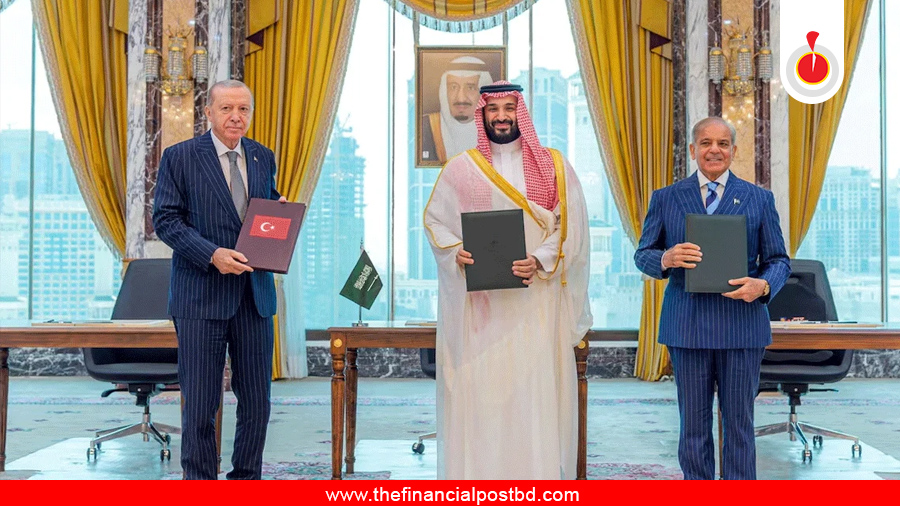
 Collected Photo
The full text of a joint defence agreement signed by Turkey, Saudi Arabia and Pakistan has been made public, outlining commitments on mutual defence, military cooperation, intelligence sharing and defence industry development.
The Turkish government submitted the text of the agreement to the country's parliament on Tuesday, October 20, for approval. Signed in Mecca on August 7, the 16-article pact states that an armed attack originating from outside against any one of the three countries will be considered an attack against all three.
Under the agreement, the other members will assist the country under attack using available means and capabilities, including military resources where appropriate. However, the scope and nature of assistance will depend on an assessment of the situation and the resources available to each country.
The British news outlet Middle East Eye has published the full text of the agreement. The pact does not identify any specific country or region as a threat but emphasises the protection of the members' independence, sovereignty, territorial integrity and internationally recognised borders.
Mutual Defence at the Core of the Agreement
Article 1 commits the three countries to cooperate in safeguarding one another's independence, sovereignty, territorial integrity and internationally recognised borders.
It also states that the members will take necessary measures if any country's territorial integrity, sovereignty or recognised borders face a threat or danger.
Article 2 sets out the agreement's central mutual-defence provision. It states that an armed attack originating from outside against any one member will be regarded as an attack against all members. If a country suffers an armed attack or military aggression by another country or a group of countries, the other members will provide immediate assistance.
The agreement also refers to the right of self-defence recognised under Article 51 of the United Nations Charter. The nature and extent of assistance will be determined through an objective assessment of the needs of the affected country, taking into account the available resources and capabilities of the other members.
The pact shares a principle with Article 5 of NATO's founding treaty, which addresses collective defence. However, the two arrangements have distinct legal frameworks and implementation mechanisms.
Defence Industry, Training and Intelligence Cooperation
Articles 3 to 7 outline measures to strengthen defence and security cooperation among the three countries.
The agreement encourages closer ties between their armed forces through personnel exchanges, joint training programmes and military exercises. These activities may take place during both peacetime and wartime to improve coordination and operational compatibility.
The countries also intend to promote cooperation in the defence industry through technology transfers, joint research and development, and the joint production of military equipment.
The agreement further provides for specialised training, the exchange of expertise and cooperation between defence research institutions and industrial organisations.
Under Article 5, the three countries will strengthen joint efforts to combat terrorism in its various forms, particularly activities that negatively affect regional and international stability and security.
Article 9 provides for intelligence sharing through mutually agreed secure channels. The countries are required to protect the security and confidentiality of exchanged information and comply with applicable data-protection requirements.
Arms and Military SuppliesArticle 10 provides for logistical and supply assistance among the members, subject to availability and compatibility.
The assistance may include weapons, ammunition, fuel, spare parts and other essential equipment during peacetime, wartime and other emergencies.
The agreement also establishes a framework for legal cooperation and the protection of classified information. Under Article 13, classified information and documents obtained under the pact cannot be shared with outside states, companies or individuals.
Access to such material will be restricted to authorised personnel with the appropriate security clearance and a legitimate need to access it.
Strategic Political and Defence CommitteeArticle 8 provides for the establishment of a Strategic Political and Defence Committee comprising the foreign ministers, defence ministers and chiefs of the armed forces of the three countries.
The committee will provide strategic guidance on collective defence, strengthen security cooperation and address obstacles to implementing the agreement.
It will meet twice a year, with the three countries hosting meetings on a rotating basis. The leaders of the member states may also meet annually if they consider it necessary.
The committee may establish subcommittees and oversee discussions on additional agreements or protocols needed to implement the pact.
It will also have the authority to establish rules and procedures for admitting additional members, subject to the unanimous agreement of the three founding countries.
A secretariat will be established in Saudi Arabia to support the committee's work. Its secretary-general will serve a three-year term, with the position rotating among the three members. The first secretary-general will be a Pakistani national.
Withdrawal Permitted After 10 YearsArticles 14 and 15 set out procedures for resolving disputes and amending the agreement. Any disagreement over the interpretation or implementation of the pact must be resolved amicably through consultations and negotiations. Amendments will require discussions and unanimous agreement among the three founding members.
Article 16 states that the agreement will remain in force indefinitely, with no fixed expiration date.
However, no member may withdraw during the first 10 years after the agreement enters into force. After that period, a member wishing to withdraw must notify the other countries in writing through diplomatic channels at least three months in advance.
Withdrawal will not affect ongoing activities or projects agreed upon before the withdrawal takes effect. Obligations concerning the protection of classified information will also continue after withdrawal or termination of the agreement.
The pact will enter into force after all three countries complete their respective domestic approval procedures. Its effective date will be the date on which the final instrument of approval is deposited with the secretariat of the Strategic Political and Defence Committee.
The agreement was signed in three original versions—in Turkish, Arabic and English. All three texts are considered equally authentic, although the English version will prevail in the event of discrepancies in interpretation.
The agreement marks an effort by Turkey, Saudi Arabia and Pakistan to establish a more structured framework for defence cooperation. Its practical impact will depend on domestic approval, implementation and the extent to which the three countries develop their military and diplomatic coordination.
FP/MIB