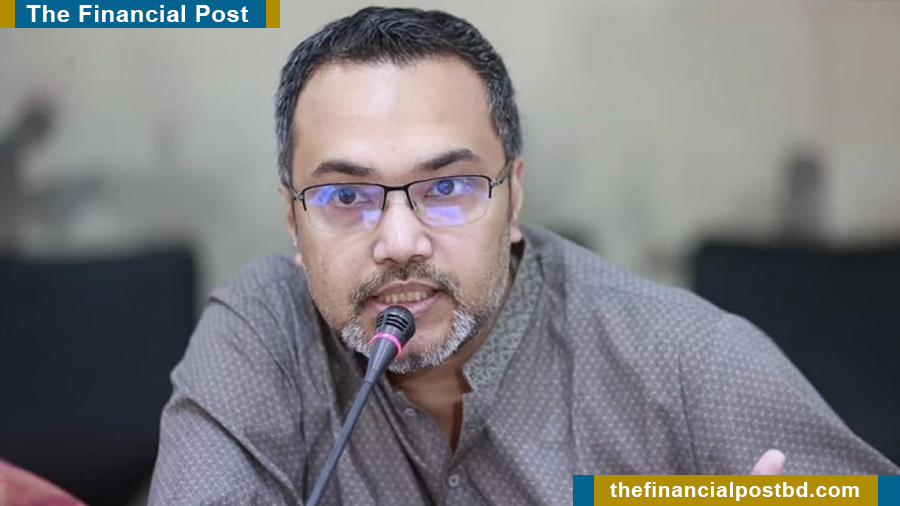
Adviser to the Prime Minister on labour and employment, Mahdi Amin, has said that the Prime Minister believes working people are the primary driving force behind a nation’s development, prosperity and progress.
He stressed that industries, agriculture, infrastructure and a strong economy are built on the tireless efforts of workers. Ensuring their improved living standards, fair rights, safe working conditions and social dignity must therefore be a priority for any responsible government.
He made the remarks on Friday at an event organised by the Ministry of Labour and Employment at the China-Bangladesh Friendship Exhibition Center in the capital, marking the historic May Day.
Mahdi Amin, who holds responsibilities equivalent to a state minister, oversees multiple portfolios, including the Ministries of Education, Primary and Mass Education, Expatriates’ Welfare and Overseas Employment, and Labour and Employment.
At the outset of his speech, he paid tribute to those who sacrificed their lives during the Haymarket Affair in Chicago in May 1886, which helped establish the eight-hour workday, as well as to workers worldwide who have struggled for rights since then.
He said Ziaur Rahman, the martyred president and proclaimer of Bangladesh’s independence, believed that the labour force was the key to national development. He highlighted Ziaur Rahman’s initiatives, including the creation of overseas labour markets—particularly in the Middle East—which continue to contribute significantly to the economy.
The adviser said successive governments led by the Bangladesh Nationalist Party (BNP) had undertaken major initiatives to improve workers’ welfare, including labour law reforms, wage commissions, minimum wage implementation for garment workers, and the establishment of welfare foundations, alongside healthcare and education support for workers’ families.
He added that ensuring workers’ rights, safe workplaces and socio-economic protection remains a priority under the leadership of Prime Minister Tarique Rahman.
Mahdi Amin noted that Bangladesh has ratified 39 conventions and one protocol of the International Labour Organization (ILO), reaffirming the government’s commitment to maintaining international standards in labour rights and welfare.
Under the Prime Minister’s directives, initiatives are being taken to ensure timely payment of wages, periodic wage reviews, equal pay for men and women, and protection for migrant workers. He also mentioned plans to introduce a ‘probashi card’ for expatriate workers.
“The Prime Minister has made it clear that ensuring workers’ safety, dignity and welfare is essential to building a prosperous, self-reliant, democratic and humane Bangladesh,” he said.
He further stated that the first session of the 13th Jatiya Sangsad marked a new milestone in democratic politics under the leadership of Prime Minister Tarique Rahman, reflecting a statesmanlike vision that places national interest above party considerations.
The adviser said that while ideological differences exist between the BNP and other political parties—both historically and in areas such as women’s empowerment—there is no alternative to cooperation and collective efforts to advance the country, strengthen democracy and address public concerns.
He emphasised that prioritising the nation above political divisions is central to Bangladeshi nationalism, adding that the vibrant parliamentary session reflected the aspirations of the people through open debate, freedom of expression and a commitment to human rights.
Mahdi Amin said the government would continue its reform initiatives under the Prime Minister’s leadership, focusing on women’s empowerment, youth development and workers’ welfare. He stressed that ensuring employment, enhancing skills and guaranteeing safe working conditions would form the foundation of sustainable development in Bangladesh.
The event was also attended by President Mohammad Shahabuddin, Prime Minister’s Political Adviser and BNP Standing Committee member Nazrul Islam Khan, Labour and Employment Minister Ariful Haque Chowdhury, the ILO country director, as well as leaders of labour organisations and industrialists.
FP/MI






 UN's Guterres says money owed by US is 'non-negotiable'
 This honour belongs to the people: Runa Laila
 Sramik Dal’s rally begins at Nayapaltan
 Rain and runoff trigger spawning activity in Halda river
 City Submerged After Excess Rainfall; Three-Point Solution Proposed
 11.89 lakh Rohingyas now in Bangladesh: Foreign Minister
 14,500 new posts to be created in police: Home minister
 9 more children die from measles, symptoms