Agriculture Department Expects Sales Worth Tk 20–25 Crore This Season
Md. Masum Khan, Jhalakathi District Correspondent
Published : Tuesday, 1 September, 2026 at 5:28 PM Count : 109
PC: Md. Masum Khan
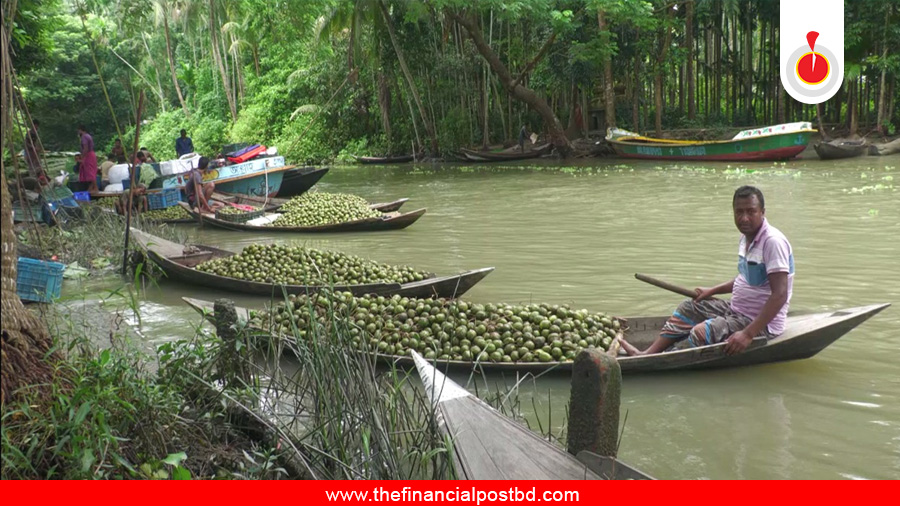
Boats lined up on the water, loaded with fresh hog plums (amra), have transformed Jhalakathi’s rivers into a lively marketplace. Traders moving from boat to boat, bargaining, buying and selling, and transporting goods have created a vibrant atmosphere as the traditional floating amra market begins its seasonal activities in Bhadra.
From morning till evening, the market remains busy with the arrival of wholesalers, retailers and local traders from different parts of the country, turning this southern district into a hub of agricultural trade.
A significant portion of the fruit popularly known across Bangladesh as “Barisal’s amra” is produced in Jhalakathi. The amra season begins every year after the end of the guava season and continues for nearly two months. During this period, markets are set up both on land and waterways across the district.
Among these, the floating markets of Bhimruli, Shatdashakathi, Dumuria, Kafurkathi, Himanandankathi, Ata and around 10 nearby villages under Jhalakathi Sadar Upazila are particularly famous. From these markets, amra is transported to different parts of the country through waterways and roads.
At the beginning of the season, wholesale prices of amra are currently ranging between Tk 1,000 and Tk 1,200 per maund. Local traders and wholesalers are purchasing the fruit directly from farmers and supplying it to markets across the country. Farmers and traders expressed satisfaction as both production and sales have been good this year.
The amra trade has also created seasonal employment opportunities in the region. Hundreds of people, including farmers, labourers, small vendors, boatmen and transport workers, are earning their livelihoods around this seasonal business. Meanwhile, tourists from different parts of Bangladesh are also visiting Jhalakathi to experience the unique sight of the floating market.
Local farmers said the soil and climate of the southern region are highly suitable for amra cultivation. The fruits grown in Jhalakathi are relatively larger in size and have a good taste. Many orchards produce healthy yields with limited use of fertilisers and pesticides.
Farmers Md. Nazrul Hawlader, Md. Iqbal Chowdhury, Alok Halder, Jatin Halder, Sumon Mollah, Bhaben Roy, Pulak Halder, Sanjay Mistry, Anjan Halder, Amaresh Roy and Bipul Halder said, “The soil and climate of Jhalakathi are ideal for amra cultivation. Due to good production, the number of orchards is increasing every year. After the opening of the Padma Bridge, amra can now be delivered to different parts of the country within a shorter time, allowing farmers to receive better prices.”
A farmer collects fresh hog plums from the trees as Jhalakathi’s amra season gets underway. PC: Md. Masum Khan
They added that depending on the variety and size of the tree, a single amra tree can generate several thousand taka in income. Another advantage of amra is that it remains fresh for a longer period compared to many other fruits, making transportation to distant markets easier.
The Jhalakathi Agriculture Department said amra cultivation is increasing every year due to low production costs and growing market demand. The department also highlighted that improved transportation facilities after the Padma Bridge have helped farmers access wider markets.
According to the Agriculture Department, amra has been cultivated on 605 hectares of land in Jhalakathi this year. The district is expected to produce around 4,590 metric tonnes of amra during the season.
Boats loaded with fresh amra arrive at Jhalakathi’s floating market as the seasonal trade gains momentum.. PC: Md. Masum Khan
The department estimates that amra worth around Tk 20–25 crore could be sold from different villages of Jhalakathi this season.
As a result, the amra season has brought economic activity not only to farmers’ orchards but also to the wider rural economy. The unique floating market, operated through boats, has now become both a major agricultural trading centre and an emerging tourist attraction of Jhalakathi.