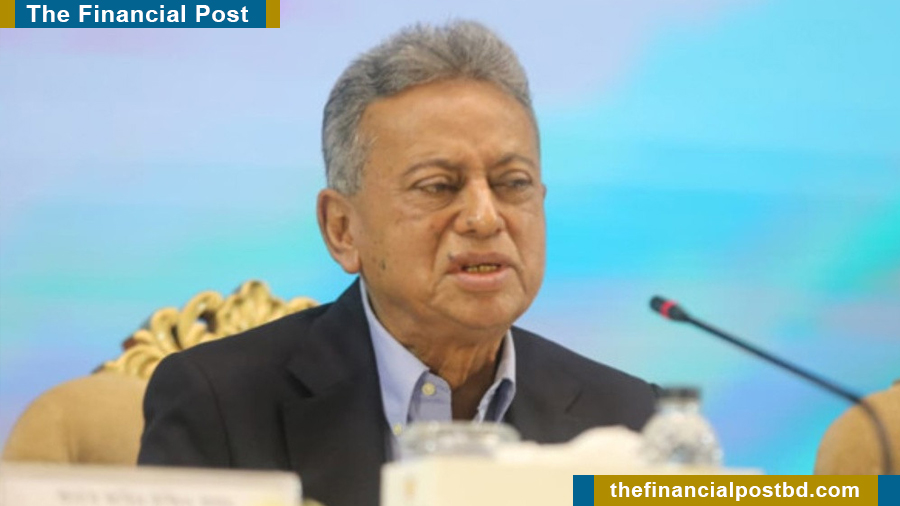
Finance Minister Amir Khosru Mahmud Chowdhury on Friday defended the government's record Tk9.38 lakh crore national budget for FY2026-27, describing it as an inclusive and people-centred financial plan designed to reflect the aspirations of citizens following years of political struggle and economic challenges.
Speaking at a post-budget press conference at Osmani Memorial Auditorium, the finance minister said the budget was formulated through extensive consultations and aimed to bring every segment of society into the country's economic framework.
"When we speak about a budget, we are essentially talking about reflecting the will of the people," he said, arguing that the newly elected government had sought to translate public expectations into policy following the 12 February parliamentary election.
The finance minister said the budget was prepared under exceptional circumstances, citing what he described as a weakened economy, institutional erosion and fiscal constraints inherited from previous administrations, compounded by global economic uncertainties and geopolitical tensions.
"We have tried to ensure that no group, profession, religion or community remains outside the scope of this budget," he said.
The FY27 budget, unveiled in Parliament on Thursday, proposes a record expenditure of Tk9.38 lakh crore alongside a Tk3 lakh crore Annual Development Programme (ADP), making it the largest fiscal package in the country's history.
The government has framed the budget around the theme of "Economic Democratization and Deregulation: Bangladesh's Journey Towards a Trillion-Dollar Economy", signalling a shift towards broader participation in economic opportunities and reduced regulatory barriers to investment.
According to the finance minister, one of the central objectives of the budget is to move away from what he termed a "patronage-based economy" towards a more inclusive model that creates opportunities for citizens who have traditionally remained outside organised economic structures.
He said the government had attempted to provide allocations, policy support and implementation roadmaps for a wide range of social and economic groups despite significant resource limitations.
The budget places particular emphasis on human capital development, with increased focus on education, healthcare, employment generation, entrepreneurship and social protection programmes.
Khosru acknowledged that the government faces considerable economic challenges, including inflationary pressures, energy-sector vulnerabilities and an increasingly uncertain global economic environment marked by conflicts, trade disruptions and growing protectionism.
He argued that traditional rule-based global economic arrangements are under strain, creating additional challenges for developing economies such as Bangladesh.
To improve the efficiency of public spending, the finance minister said future projects would be evaluated against four key criteria: value for money, return on investment, job creation and environmental sustainability.
"We want every taka spent by the government to generate measurable economic and social returns," he said.
The government has projected GDP growth of 6.5% and inflation of 7.5% in FY27, while simultaneously pursuing structural reforms aimed at stimulating private investment, improving the ease of doing business and expanding employment opportunities.
The finance minister described the budget as fundamentally different from previous fiscal plans, arguing that it combines economic reform with a broader commitment to accountability, inclusiveness and democratic governance.
He concluded by stressing that public accountability remains a core responsibility of an elected government and welcomed scrutiny from parliament, the media and citizens regarding the implementation of the budget.
FP/MI