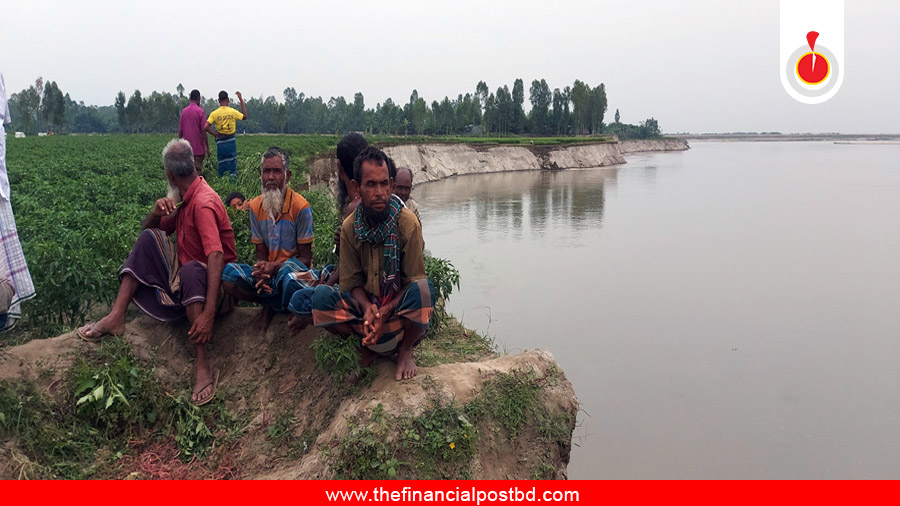
 Collected PhotoSevere river erosion along the left bank of the Jamuna River in Islampur Upazila of Jamalpur has caused widespread concern among local residents, particularly farmers. The erosion has affected an area stretching approximately five kilometres, swallowing residential houses and hundreds of bighas of agricultural land. Markets, schools, madrasas and other establishments are also at risk.
Local farmers have been left devastated as large areas of cultivable land continue to disappear into the river. Meanwhile, the Jamalpur Water Development Board (WDB) has said that a survey is underway to assess the situation and determine the necessary measures to prevent further erosion.
According to local residents, direct road communication between Islampur Upazila headquarters and Sapdhari Union existed until the 1980s. However, successive waves of river erosion during the latter part of that decade gradually destroyed the road connection. Over the years, erosion has transformed approximately 20 villages into isolated char settlements.
For nearly two decades, continuous erosion along the Jamuna has gradually advanced eastward, affecting areas including Gutail, Ulia, Hargila, Tartapara and Kathma in Islampur Upazila.
During the previous government's tenure, the Jamalpur Water Development Board constructed concrete-block riverbank protection structures along sections stretching from Futani Bazar in Dewanganj to Kulkandi and Gutail in Islampur, as well as Ulia Bazar. Following the construction of these protective structures, the river's strong currents gradually shifted towards its main channel.
As new char lands emerged and became suitable for habitation, local people established settlements and resumed agricultural activities. Around 20 new villages gradually developed on the newly emerged land. Areas of Shildah, Sindurtali and Chinaduli unions, including Char Anandanpara, Kukur Mari, Kutubulla Char and Naya Para, also developed into densely populated settlements and agricultural zones.
However, the hopes of the newly settled char residents are now under threat. Locals allege that illegal sand extraction and unplanned excavation of the river by influential individuals have contributed to changes in the river's flow. As a result, two new channels have developed through the emerging char areas, triggering fresh erosion.
A visit to the affected areas revealed severe erosion in Mandalpara, Akandapara, Bisharashi, Sukhchar, Char Shishua and Prajapati, as well as parts of Shildah and Sindurtali in Belgachha Union. Agricultural land is disappearing into the river, sometimes within a very short period.
Azizur Rahman Chowdhury, a resident of Sapdhari, said, "Our ancestors spent their lives fighting the erosion of the Jamuna River, moving from one char to another. Generations of people in this area have been struggling to protect their homes and livelihoods from river erosion."
He called on the local Member of Parliament and the relevant authorities to take immediate steps to protect the affected communities.
Sapdhari Union Parishad Chairman Shah Alam Mandal said erosion was currently occurring along an approximately five-kilometre stretch.
"If the erosion continues at this rate, our union could eventually disappear from the map. We urgently need the intervention of the local administration and the relevant authorities," he said.
Islampur Upazila Nirbahi Officer (UNO) Shah Md. Jabayer said he had already discussed the situation with the Water Development Board and requested necessary measures to prevent erosion in Sapdhari Union. He expressed hope that effective steps would be taken soon.
Jamalpur Water Development Board Executive Engineer Md. Naqibuzzaman said a study was underway to identify appropriate measures to prevent erosion along the Jamuna River and its adjoining char areas. Sustainable interventions would be undertaken following instructions from the higher authorities.
Local Member of Parliament Alhaj Sultan Mahmud Babu said river management initiatives were already underway in the upazila. He added that several measures had been planned to improve the management of the Jamuna River and that erosion-control work would begin soon.
FP/MIB